• Skip to secondary menu
  • Skip to main content
  • Skip to primary sidebar

Shuffle Projects

Swinging Projects for Lindy Hop & Balboa Dancers

  • HOME
  • ABOUT
  • DJ CHRiSBE
    • Song of the Week
  • RESOURCES
  • CONTACT

Dance

30 Week Lindy Hop Challenge: Your Favorite Place To Dance

20.07.2012 by Chris

Every Friday for thirty weeks, I will write about a topic from the list of the «30 Week Lindy Hop Challenge«.

Let's jump into the second week.

Week #2: Your Favorite Place To Dance

30 Week Lindy Hop Challenge on Shuffle Projects

Usually, I don't like it that much to choose a favorite something.

Especially in the swing scene, there are so many different and distinctive things going on, that it's really hard to decide on one.

But this one here is easy.

My favorite place to dance is

HERRÄNG!

This place is unique.

This place is magic.

This is a place you have to have visited at least once in your swing dance career. Otherwise, you have missed something.

My first time at Herräng Dance Camp was in 2000 and I have been there many times since then. It changed a lot, it got bigger and more professional but it didn't loose its character.

Too bad, that I couldn't make it this year. But I will be back next year!


<< Last Friday: #1 What got you started in Lindy Hop

>> Next Friday: #3 A description of your favorite dance partner

Filed Under: Dance Tagged With: 30 Day Lindy Hop Challenge, 30 Week Lindy Hop Challenge, Herräng Dance Camp, Lindy Hop

30 Week Lindy Hop Challenge: What Got You Started In Lindy Hop

13.07.2012 by Chris

As announced last week, today I'm going to start a new series.

Every Friday for thirty weeks, I will write about a topic from the list of the «30 Week Lindy Hop Challenge«.

Week #1: What Got You Started In Lindy Hop

30 Week Lindy Hop Challenge on Shuffle Projects

It was somewhen in 1995, when I saw a dance show in my hometown. A group of four dancers (I think) showed a Charleston and a Lindy Hop number. Maybe more, I don't remember the details to be honest. But I remember the atmosphere. It was magic!

I always liked Charleston moves, the energy of Lindy Hop (without knowing, that this dance was called like that) and the fashion of the swing era.

At that time, I took ballroom and other dance classes at the local dance school and we were a clan of a few people spending a lot of time together.

One day, we watched «Swing Kids» and again I was impressed by the dancing.

I had to learn those dances.

So, in 1997, I attended the Swiss Lindy Hop Weekend. I had never danced Lindy Hop before but of course, I didn't register for the lowest level. Hey, I'm a dancer ;).

Man, that was hard when we had to do some warm up dances and I had no idea about swing out, bounce and whatsoever. Somehow, I dealt with the situation and it worked quite okay (at least in my point of view…).

After the weekend, I didn't dance Lindy Hop at all. And one year later, I did exactly the same thing again and attended that event. But still, I didn't keep on dancing Lindy afterwards.

One year later, the same dance school offered Lindy Hop classes for beginners and that was my chance to learn the dance from scratch.

And eventually, on Sunday, September 26 in 1999, at 5.30 pm, my Lindy Hop career started.

That's why, I always indicate 1999 as my starting year.


> Next Friday: #2 Your favorite place to dance

Filed Under: Dance Tagged With: 30 Day Lindy Hop Challenge, 30 Week Lindy Hop Challenge, Lindy Hop

30 Week Lindy Hop Challenge on Fridays

06.07.2012 by Chris

You should join the #30dayswingchallenge 🙂

30 Week Lindy Hop Challenge on Shuffle Projects

That was Katie Sewell's tweet after we got connected on Twitter.

I haven't heard about the «30 Day Lindy Hop Challenge» before, so I checked it out:

The idea behind the challenge is to write every day about a topic related to Lindy Hop for the next 30 days.

Well, I have decided to join the challenge, but I will do a little twist.

I won't write every day but every Friday from now on for the next 30 weeks! How about that?

Here are the topics:

30 Week Lindy Hop Challenge

  • Week 1: What got you started in Lindy Hop
  • Week 2: Your favorite place to dance
  • Week 3: A description of your favorite partner (and why they’re your favorite)
  • Week 4: Your favorite live band
  • Week 5: Your favorite Lindy Hop variation dance (charleston, balboa, shag)
  • Week 6: Your favorite group dance (shim sham, tranky doo big apple, etc)
  • Week 7: Something you really want to learn
  • Week 8: Your favorite instructor
  • Week 9: Favorite class taken
  • Week 10: Favorite workshop weekend (Lindy Focus, Camp Hollywood, etc) or one you’d really like to attend
  • Week 11: Favorite song(s) to dance to
  • Week 12: Your swing crushes/favorite pros
  • Week 13: Favorite dancing memory
  • Week 14: Your swing group of friends
  • Week 15: Favorite classic clip
  • Week 16: Photo of you dancing
  • Week 17: Styling
  • Week 18: That move you love
  • Week 19: That move that eludes you
  • Week 20: Your swing shoes
  • Week 21: Favorite outfit to wear dancing
  • Week 22: Favorite city to dance in
  • Week 23: A dancer you admire
  • Week 24: Favorite pro performance
  • Week 25: Describe the last night you went dancing
  • Week 26: The level you think you dance at
  • Week 27: Your goals for the year
  • Week 28: Events you’re looking forward to
  • Week 29: A clip you love
  • Week 30: Why you dance

You see, you will learn a lot about me, my thoughts and ideas about Lindy Hop and Swing dancing in general.

Are you curious? I am!

Stay tuned! We will start next Friday.

Photo: mzacha

Filed Under: Dance Tagged With: 30 Day Lindy Hop Challenge, 30 Week Lindy Hop Challenge, Lindy Hop

Why The Balboa Experiment Helps You To Become A Better Dancer

04.05.2012 by Chris

First of all, I don't get paid or receive any benefits for writing this blog post. This article represents my personal opinion. 😉

Balboa Experiment House

A highly intensive Balboa workshop

Quote from the website:

The Experiment is a highly intensive Balboa workshop built around the model of small, select groups of participants spending a week together with top dancers of our generation in an extraordinary live+work+play environment.

My first contact with The Experiment

It was back in Summer 2008, I was attending the Studio Hop Summer Camp, when I heard the first time about The Experiment. Mastermind David Rehm, who was teaching there, was handing out flyers about the event. He was painfully mysterious about the event. When we asked him what The Experiment is, he always redirected us to the website.

Balboa Experiment Practice SessionAs a matter of fact, the first Experiment in 2009 was very exclusive. Only one week, only 24 students. You can imagine the high competition between the appliers to get a spot.
I was hooked from the beginning. In that year, I knew I can't apply because of my dance level but I also knew that I wanna go there as soon as possible.

One year later, the event was advertised again, and this time with 2 weeks with 24 students each. I applied and to my big surprise I got accepted. I was excited and terrified at the same moment!

In this year (2012), I attended The Experiment already for the third time. The event has meanwhile grown to three weeks with 28 students each.

What didn't change over the years is the fascination and the concept of the event.

What Is So Unique About The Experiment?

I have already written about this last year in «A Day At The Balboa Experiment«. Let me summarize one more time, what distinguishes The Experiment from all the other camps and workshops:

Sessions instead of lessons/classes

Usually, there is a morning session and an afternoon session. Some of these sessions have specific topics, chosen by the staff, and some are open (without a topic) and free to use. Examples of sessions are: watching old clips and try to copy what you see, Ask & Tell, feedback session after competition, etc.

Instructors act as coaches and mentors

Some sessions are created and led by specific instructors but mainly they are coaching and mentoring. As a student you have to be pro-active, though. In other words, you have to ask them for feedback.

Driven by the students

The primary goal is, that the participants teach, inspire and give feedback to each other. The students are all high level dancers (advanced/advanced plus/masters). It's simply amazing how much knowledge and experience comes together in such a place. It would be a big waste, if there wouldn't be a possibility to share and exchange that knowledge.

Combination of practicing, living, socializing, playing, …

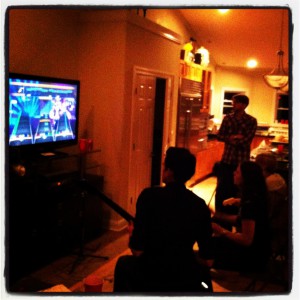
Balboa Experiment Playing Rock BandYou know that from your own experience. You spend hours with the same people again and again at workshops and events but basically, you don't know that much about them unless your common passion for the dance.

Here, everything is happening at the same place, means: in the Experiment House. Sleeping, eating, working, playing, hanging out, social dancing, etc.

There is plenty of time to get to know your peers better and in a different way.

Feedback

I don't know any other place where I get honest feedback about my dancing from my peers. This fact helped me the most in the last few years to grow and to become a better dancer – and also a better dance teacher!

You Should Apply As Well

If one or more of these points resonate with you, then you should apply for the next Experiment.

Even if you're not an advanced dancer so far and you are interested in such a learning environment, apply! Who knows the future, maybe there will be a Balboa Experiment with 4 weeks!?

Filed Under: Dance, Education Tagged With: Balboa, The Balboa Experiment, Workshop

Musicality for Swing Dancers: AABA 32-bar song form

13.04.2012 by Chris

«Learn about the AABA jazz form» is the seventh tip in my article «33 Actions & Tips To Become A Better Swing Dancer«.

The interest in this tip is huge, reason enough to examine the AABA form in a separate article.

After the introduction, we will take a look at the theory.

Then we will listen to an example, where the AABA form is used.

And finally, you will learn a basic idea, how to implement AABA into the dance by using a simple routine.

Musicality for Swing Dancers AABA 32-bar form | Shuffle Projects

Introduction

The AABA form was style-defining for the popular music of the United States. It is the basic form of most of the so-called Tin Pan Alley songs.

Tin Pan Alley was the nickname of the 28th Street between Fifth and Sixth Avenue in Manhattan New York. Between ca. 1895 and 1930, a majority of music publishers were settled in this district and responsible for the flourish of the American popular song during that time.

Many songwriters and composers worked for these publishers. The songs were published as sheet music, the base for an essential part of the Jazz standard repertoire.

Theory of AABA or thirty-two-bar form

Many of the so-called jazz standards (and thousands of more tunes) are written in the AABA form.

The AABA form usually consists of 32 bars.

These 32 bars are divided in four 8 bar sections: Two A sections or verses, a B section or «Bridge» (also: middle eight) and another A section or verse:

A – 8 bars
A – 8 bars
B – 8 bars
A – 8 bars

The first two A sections (A1 and A2) are verses with similar chords and a similar melody, while the lyrics may change.

The following bridge builds a contrast to the A sections using different chords, a different melody and different lyrics, before it is transitioning to another A.

This last A section (A3) repeats the first two A's with similar chords and a similar melody. The lyrics may be different or one verse may be repeated.

Important to know for us dancers: musicians always count on 4 while we are counting on 8. With that said: 8 bars = 4 eights.

Example: «Take The ‚A‘ Train»

Artist: Duke Ellington & His Orchestra, 1941
Composer: Billy Strayhorn

Song structure:

0:00-0:06  Intro (4 bars)

0:06-0:52  A A B A

0:52-1:38  A A B A

1:38-1:43  Transition (4 bars) with key change

1:43-2:29  A A B A

2:29-2:52  last A repeated another two times and fading out

Musicality for Swing Dancers: How to Use the AABA Form

Here is a basic idea, how you can implement the newly acquired knowledge into your dance.

Let's create a short routine:

Section A1 – first four eights:

  • Swingout
  • Swingout
  • Swingout with inside turn
  • Mini dip

Section A2 – second four eights:

  • Swingout
  • Swingout
  • Swingout with outside turn
  • Lindy Circle

Section B (bridge) – third four eights:

  • Side-by-side Charleston
  • Side-by-side Charleston
  • Side-by-side Charleston
  • Kick-the-dog / Skip-up

Section A3 – fourth four eights:

  • Swingout
  • Texas Tommy
  • Swingout
  • Lindy Circle

I guess, you get the idea: We rebuild the AABA form with different Lindy moves.

A sections are danced with swingouts and variations of them: A1 and A2 are similar, but not exactly the same. The bridge is done with side-by-side charleston to contrast the A's, and A3 is the exact copy of A2 to show the relation to each other.

When we do something like this, then we talk about «macro musicality«.

If you feel comfortable with building four eights sections, then you can start to create more complicated variations. With the time, you don't only dance the main melody, you become a soloist, who improvises freely without loosing the structure, like the musicians in any of these songs!

How do You implement the AABA form into your dance?

I would love to read your stories in the comment section below.

  • How did you learn to implement the AABA form?
  • How would you teach it?
  • Any other ideas to the topic?

Sources:

  • Exploring the AABA form in Songwriting
  • Tin Pan Alley

Filed Under: Dance, Music Tagged With: 32-bar form, AABA, Knowhow, Musicality, Swing Dance

  • « Go to Previous Page
  • Page 1
  • Interim pages omitted …
  • Page 3
  • Page 4
  • Page 5
  • Page 6
  • Page 7
  • Interim pages omitted …
  • Page 14
  • Go to Next Page »

Primary Sidebar

Welcome, I'm Christian Bossert. Since 1999, I‘ve been passionate about Swing dances as well as their culture and history. I‘m a Swing dance instructor and international Swing DJ Chrisbe, based in Zurich Switzerland. Read More…

Neueste Beiträge

  • Alphabetical Jazz Steps – Edition 3 (2017) with Chester Whitmore
  • Marcia & Chris unterrichten bei Dance2bee in CH-Muhen, 10.-13.07.2017
  • WhatStep – Your Dance Move Assistant App: The Story
  • Februar-Aktion: 15 % auf iTunes Geschenkkarten
  • Marcia & Chris are teaching Balboa in D-Dortmund, 27.-29.11.2015

Most Popular Posts

  • 33 Tips & Actions How To Become A Better Swing Dancer
  • Swing Summer in Europe: Studio Hop Summer Camp in Eauze France
  • Competing at ABW and ESDC
  • Dance Teaching Idea: Ask & Tell
  • A Day At The Balboa Experiment
  • Frankie Manning: Never Stop Swinging (Documentary)
  • 14 Tips To Become A (Better) Swing DJ

Copyright © 2025 · Lifestyle Pro on Genesis Framework · WordPress · Log in