• Skip to secondary menu
  • Skip to main content
  • Skip to primary sidebar

Shuffle Projects

Swinging Projects for Lindy Hop & Balboa Dancers

  • HOME
  • ABOUT
  • DJ CHRiSBE
    • Song of the Week
  • RESOURCES
  • CONTACT

Dance

Random Clips on Friday: Collegiate Shag

04.11.2011 by Chris

I have the feeling that there is an increasing interest in Collegiate Shag.

Do you know how Collegiate Shag looks like? Here are two clips.

Arthur Murray's Collegiate Shag (1937)

A compilation with a demonstration of basics of Double Collegiate Shag, a showcase of several dancers and an evening group routine performance.

Collegiate Shag by the San Francisco Jitterbugs

A mixture of contempary Collegiate Shag dance scenes and some from the clip above.

The History of Collegiate Shag

Check out this website if you wanna learn more about the history of Collegiate Shag. The front article on the website is by Peter Loggins. He's also one of the dancers in the second clip!


So, after watching these clips, would you like to learn Collegiate Shag?

[catalyst_hook_box name=»signup»]
Related Posts:

Random Clips on Friday: Tranky Doo

Filed Under: Dance, History/Culture Tagged With: Arthur Murray, Clips, Collegiate Shag, Peter Loggins, Video

Shim Sham Flash Mobs in Bern

17.10.2011 by Chris

Last Saturday, 15. October 2011, the Lindy Hop association Swing Machine in Bern Switzerland organized two flash mobs at the train station in the middle of the city. Here are the two clips:

Shim Sham No. 1


Shim Sham No. 2


I especially like Shim Sham No. 1 because of the location. The destination board in the background is quite impressive.

Which one is your favourite?

Actually, we should also organize swing flash mobs in Zürich!

[catalyst_hook_box name=»signup»]

[catalyst_hook_box name=»share»]

Filed Under: Dance, Swing News Tagged With: Bern, Flash Mob, Lindy Hop, Shim Sham, Swing Machine, Switzerland

Bal-Swing Out-and-In: New Blog Post and Clip by Nick Williams

22.09.2011 by Chris

Yesterday, Nick Williams published an interesting article about the Out and In in Bal-Swing and how he and his dance geek friends managed to find this missing motion to make their own Bal-Swing look like the oldtimers danced it.

Here is the link to the article called «Out and In-terest»

Private Lesson Footage with Maxie Dorf «Out and In»

Included in the article and also just released on YouTube is this clip

This is awesome footage and I'm really happy, Nick is releasing these clips. I especially like Maxie Dorf's style of sliding. I immediately want to work more on this technique!

What do you think about Nick's blog post and clip? Please leave a comment!

Related posts:

Index of Basic Classic Dance Clips – Compiled by Bobby White
Balboa History – Wie alles begann (in German)

If you enjoyed this post, please tweet, «like», +1, or share it. Thank you!

Filed Under: Dance Tagged With: Bal-Swing, Balboa, Clips, Maxie Dorf, Nick Williams

Swing Dance Competition: Relative Placement Scoring System

10.09.2011 by Chris

Relative Placement Scoring System in Swing Dance Competitions | Shuffle Projects

Have you ever wondered how Swing dance competitions are scored?

Here is the answer. In this post I would like to explain you a widely accepted scoring system in the Swing dance world called Relative Placement.

What is Relative Placement

Relative Placement is a scoring system which provides a fair method to value each judge's subjective vote.  It makes sure that every judge has an equal vote on the end result, no judge has more power than the other one.

Consequently, one high or low judge is disregarded and favoritism or bias from a judge is avoided.

How does Relative Placement work

Judges

A minimum of five judges are required. Also possible are six, seven, eight or nine.

In the preliminary and semi-final round an even or odd number of judges may be used: five, six, seven, eight or nine. In Jack & Jill competitions, one half of the judges may judge leaders, the other half followers.

A final round of a competition must be judged by an odd number of judges: at least five, recommended seven, preferred nine.

Preliminary Round, Semi-Finals, Finals

In the preliminary round and if needed in the semi-finals, the competitors (single, couple or group) are not ranked in a specific order, a call-back system is used instead.

The judges select competitors for the next round (basically yes or no) and determine alternates.

The scorer (which in most cases is the head judge) transforms the selections in ordinals: 1 for the selected competitors, 2 for alternates and 3 for the unselected. According to the total number of received 1s, 2s and 3s the competitors get ranked.

The head judge determines how many competitors are promoted for the next round. There are two possibilities:

  • prefixed number of semi-finalists or finalists
  • considering the natural break in the ranking (often it occurs, that the first group of ranked competitors are close together before there is a break to the second group with the rest of the ranked competitors)

Final Placements

In the finals all the competitors (usually couple or group) get placed by the judges by defining a rank: 1st place, 2nd place, 3rd place, etc. while duplicate placements are not allowed.

For the final placement a majority is needed. If no competitor has a majority of the same placement, the next placement is added to the previous placements until a majority is reached:

  • 1st and 2nd place (= 1-2)
  • 1st, 2nd and 3rd place (= 1-3)
  • etc.

If two or more competitors have an equal majority, the numerical value of the ordinals for each competitor is added. The competitor with the lower sum get ranked higher. If the sums for two and more competitors are equal, the next placement is added to the previous placements.

Let's take a look at two examples

Examples of Relative Placement

Example 1:

Relative Placement Scoring System Example 1 | Shuffle Projects

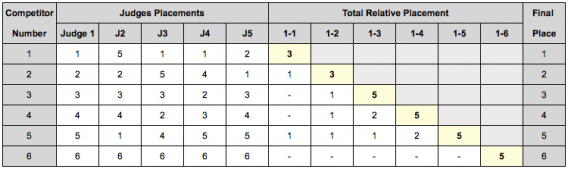
In this example, the result is clear through all competitors. The majority of votes with five judges is three.

  • Although judge 2 placed competitor #1 fifth, the majority of three judges placed them first, so the final place is first as well
  • Competitor #2 got one first place and two second place votes. Therefore 1-1 is 1 and 1-2 (1st plus 2nd) is 3.
  • Competitor #3 got no first place, one second place and four third place votes: 1-1 is 0, 1-2 is 1 and 1-3 is five (1st plus 2nd plus 3rd)
  • etc.

Example 2:

Relative Placement Scoring System Example 2 | Shuffle Projects

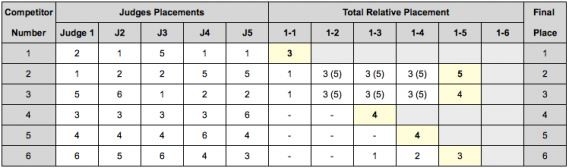
In this example we have a more complicated situation. The majority of votes is still three.

  • For competitor #1 the result is clear, the majority of judges voted them first.
  • Competitor #2 and #3 reached both the majority of three for 2nd place. Now we take the sum of the ordinals: 1+2+2=5 (written in brackets) for both competitors, we have an equal situation. Then the same procedure will be repeatet until a majority is reached. In this example the difference is eventually at 1-5.
  • Competitor #4 has more votes for 1-3 than #2 and #3, but less for 1-2, so the final place is 4.

Complete Rules

If you are interested in the complete rules, then check out Relative Placement Scoring System Rules – Compiled by Gary Kuhn. From the same website I have taken the two example cases.

Photo credit dices: plrang

What about you, do you like Relative Placement? Please leave a comment!

Related posts:

  • Competing at ABW and ESDC

Filed Under: Dance Tagged With: Competition, Contest, Dance, Relative Placement, Scoring System, Swing

Swing Out, Baby, Swing Out!

30.08.2011 by Chris


No comment!


ILHC 2011 – Showcase – Michael Darigol & Brittany Johnson

If you enjoyed this post, please tweet, “like”, +1, or share it. Thank you!

Filed Under: Dance, Funny Stuff Tagged With: Clips, ILHC 2011, Lindy Hop, Swing Out, Video

  • « Go to Previous Page
  • Page 1
  • Interim pages omitted …
  • Page 5
  • Page 6
  • Page 7
  • Page 8
  • Page 9
  • Interim pages omitted …
  • Page 14
  • Go to Next Page »

Primary Sidebar

Welcome, I'm Christian Bossert. Since 1999, I‘ve been passionate about Swing dances as well as their culture and history. I‘m a Swing dance instructor and international Swing DJ Chrisbe, based in Zurich Switzerland. Read More…

Neueste Beiträge

  • Alphabetical Jazz Steps – Edition 3 (2017) with Chester Whitmore
  • Marcia & Chris unterrichten bei Dance2bee in CH-Muhen, 10.-13.07.2017
  • WhatStep – Your Dance Move Assistant App: The Story
  • Februar-Aktion: 15 % auf iTunes Geschenkkarten
  • Marcia & Chris are teaching Balboa in D-Dortmund, 27.-29.11.2015

Most Popular Posts

  • 33 Tips & Actions How To Become A Better Swing Dancer
  • Swing Summer in Europe: Studio Hop Summer Camp in Eauze France
  • Competing at ABW and ESDC
  • Dance Teaching Idea: Ask & Tell
  • A Day At The Balboa Experiment
  • Frankie Manning: Never Stop Swinging (Documentary)
  • 14 Tips To Become A (Better) Swing DJ

Copyright © 2026 · Lifestyle Pro on Genesis Framework · WordPress · Log in